


If you run a Wisconsin business, your future customers are about to change how they use Google. In fact, for some of them, it's already happening.
You've probably noticed it yourself. Type a question into Google now and before you even scroll down, you're hit with a big block of AI-generated text. That's Google's AI Overview (AIO), and it's not going away.
On the other side, Bing Copilot is baking AI directly into Microsoft's search engine, which powers the search bar in every Windows PC and the Edge browser. These AI-powered answers are pulling information from websites and serving it directly to the searcher, often without the user ever needing to click through to your site.
The bottom line: The rules of online visibility are being rewritten, and businesses that don't adapt risk becoming invisible.
This guide cuts through the noise. We'll explain what AI Overviews and Bing Copilot actually are, what they mean for your business, and give you a practical, no-jargon action plan to make sure AI sends customers to you, not your competitor.
Quick Look: What You Need to Know
- AI-generated answers are now standard. Google AI Overviews appear for nearly half of all searches, and Microsoft Copilot is built into every Windows device.
- "Zero-click" searches are the new normal. AI answers the question directly, so users often don't click through to a website at all. Your goal is to be the source that AI trusts and cites.
- E-E-A-T is your cheat code. Google's AI prioritizes content that demonstrates real Experience, Expertise, Authority, and Trust. Generic, thin content gets ignored.
- Structured data is critical. Using Schema markup (like FAQ, Service, and LocalBusiness) tells AI exactly what your business does and where.
What Are AI Overviews & Copilot? (The No-Jargon Explanation)
Think of it this way: AI Overviews and Copilot act like a smart, well-read employee that sits between you and the customer. When someone searches "best plumber near Racine," this AI employee reads through hundreds of relevant websites, reviews, and data sources, then writes a summary answer right at the top of the search results page.
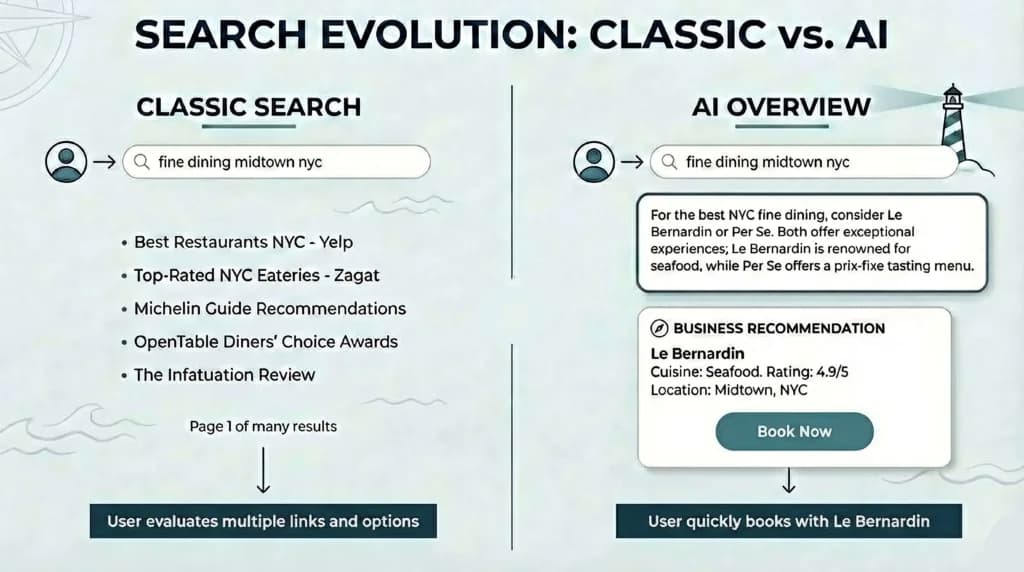
Google AI Overviews
AIO appears as a large block of text above the traditional search results. It synthesizes information from multiple sources to give the searcher a comprehensive answer. First widely rolled out in May 2024, it now shows up for an increasingly large slice of searches.
Bing Copilot
Microsoft's answer to AIO. Copilot is deeply integrated into Windows 11, the Edge browser, and the Bing search engine. When a user asks Copilot a question, it generates a conversational answer with cited sources. Given that the Edge browser is the default on every Windows PC, this is an enormous and often underestimated audience.
What This Means for Your Business (The Real Impact)
Here's the reality: AI Overviews are eating organic clicks.
Industry studies are showing that when an AI Overview appears, the click-through rate to the websites listed below it drops significantly. This phenomenon is called a "zero-click search" — the user gets their answer and never visits your site.
But here's the critical nuance: AI still needs sources. It has to pull that information from somewhere. The businesses whose websites are structured, authoritative, and well-optimized are the ones AI will cite, link to, and recommend. If you're not in that pool, you simply won't exist in the AI's answer.
Andrew's InsightThe shift from 'ranking on page 1' to 'being cited by AI' is the single biggest change in local marketing since Google Maps. The businesses that get ahead of this now will own their market for the next decade.
Your AI Visibility Playbook: 5 Steps to Get Found
You don't need to be a tech expert. You just need to build a website that AI trusts. Here's how:
Step 1: Double Down on E-E-A-T Content
E-E-A-T stands for Experience, Expertise, Authoritativeness, and Trustworthiness. It's Google's framework for evaluating content quality, and it's now the primary filter for what AI chooses to cite.
What to do: Create content that shows real experience. Write detailed guides about your specific services in your specific service area. Include your name, your credentials, and real customer case studies. The more specific and locally relevant your content is, the more AI will trust it.
Step 2: Implement Structured Data (Schema Markup)
Schema markup is code added to your website that tells search engines exactly what your business does in a language they understand perfectly. It's the difference between your website saying "We're a business" and "We are Fourth Coast Web, a custom web design agency at 123 Main St, Racine, WI 53402, owned by Andrew Hickman, specializing in WordPress performance engineering for local service businesses."
Essential schemas for local businesses:
- LocalBusiness schema: Your name, address, phone, hours, and service area.
- Service schema: What you offer, who it's for, and pricing (if applicable).
- FAQ schema: Answers to common questions, which AI loves to pull from.
- Review/AggregateRating schema: Your star rating and review count, which builds trust.
Step 3: Claim and Supercharge Your Google Business Profile
Your Google Business Profile (GBP) is the #1 source of local business data for Google's AI. A complete, optimized GBP is non-negotiable.
Ensure your GBP includes: Accurate business hours, a detailed service description, high-quality photos, regular posts/updates, and actively solicited Google reviews. AI uses all of this.
Step 4: Answer Questions Directly on Your Website
AI loves FAQ-style content because it's easy to parse and serve as a direct answer. Add a clear, well-structured FAQ section to your key pages. Think about the questions your customers call you about every day and answer them on your website.
Step 5: Build a Fast, Technically Sound Website
Google has stated repeatedly that Core Web Vitals are a ranking factor. A fast, mobile-friendly, secure (HTTPS) website is the foundation that everything else is built on. If your site is slow or broken on mobile, AI will simply prefer a competitor's source instead.
Read our Wisconsin Website Speed Guide for a deep dive into performance optimization.
Owner Tip (10 Minutes)
Try this right now: Go to Google and type in a question that your customers frequently ask you. Look at the AI Overview at the top.
- 1Is your business mentioned or cited?
- 2Is a competitor cited instead?
- 3Is the information accurate?
This 2-minute test will show you exactly where you stand in the new AI search landscape.
How Fourth Coast Web Prepares You for AI Search
At Fourth Coast Web, AI visibility is built into the foundation of every site we create. We implement full Schema markup suites, create E-E-A-T-optimized content structures, and engineer sites that are fast enough to earn Google's trust.
Every site we build on our proprietary Crest performance framework is designed from day one to be cited by AI, not just indexed by search engines. If your current site doesn't show up in AI Overviews, it's time for a conversation.
Request your free AI Visibility Audit to see exactly where you stand.